- What were Jeremy Tunstall's 4 character roles for women and do they apply to The Cabin in the Woods?
Jeremy Tunstall published his work in 'The Media in Britain' in 1983, and he looked at a wide range of existing research, and established a theme of gender representations in the media. He established 4 main representations of women in the media, and this is what he found:
- Domestic
- Consumer
- Sexual
- Marital
These particular roles make up the typical 'female' in a media text, however some are more emphasised in different media texts than others. In The Cabin in the Woods, it is interesting to see that the typical female stereotypes have been shaped to the women as soon as they enter the cabin. For example, the character of Jules has been shaped to conform to the sexual aspect of female representations. Whereas the character of Dana, could fall into the domesitc category for her need to look after her friends, and also being one of the last people to die at the end. These are only a few of the representations in the film.
 |
Dana and Jules in the cabin.
|
- How is Dana typical of Clover's 'Final Girl' theory? Please mention: the ending; Dana's appearance and her actions during the film.
One of Carol Clover's most important contributions to horror media reseach was the Final Girl Theory. This idea was risen when more and more films had a female heroine as the end of the film, instead of the stereotypical man. Modern horror films have more female heroines, therefore, based on recent research, Clover could establish the Final Girl Theory. In The Cabin in the Woods, the 'Final Girl' character is basically handed to us as it is incorporated into the plot that Dana HAS to be the final one to die, otherwise the sacrifice will not work.
The ending is significant as she survives being attacked by a werewolf, being thrown around by a zombie and also being chased whilst being at the cabin. The fact that she survived it all conforms to the Final Girl ideal, and could indicate the strength of female characters in modern media texts rather than their weaknesses. This is further supported by her fearless nature throughout the film such as her bravery for going down into the basement after being dared by Jules, and also by stabbing the zombie in the basement who initially attacked Holden. In this sense, she was more brave than he, and by defending him and protecting him showed her to be in a more dominant role. Going by this evidence, it was clear to see that she will last to the end of the film.
-
- Jules undergoes mental and physical transformations during the film, what are they and how do they cause her to become a horror archetype?
 |
Dana before being attacked by werewolf.
|
The character of Jules starts out in the movie as a college girl who likes the have fun, which is typical of the character she becomes later on. However, there is emphasis on the fact that she has dyed her hair blonde. This is a physical transformation which then makes her conform to the stereotype of 'dumb blonde' who typically dies first. This evidence suggests that she essentially falls into her stereotype which results in her being first to die, as according to the ritual which becomes clear at the end of the film. Along with her physical change to having blonde hair, her mentality changed with it. This is shown through the fact that at the beginning, she just seems to want to have fun and help her friend (Dana) have a good time by suggesting that she wears sexy underwear and leaves her college text books at home. However, it is argued that she wasn't into just having sex because whenever Curt (boyfriend) picked her up or hugged her from behind, she pulled an unimpressed face. This changes as they reach the cabin as she puts a lot of effort into making out with the wolf on the wall, and does an erotic dance by the fireplace for her male counterparts. This supports the idea that Jules falls into the stereotype of the "whore" following her physical and mental transformations.
 |
| Jules making out with the wolf. |
- Is Mulvey's Male Gaze theory exemplified in the film and if so, how? Think about: framing, camera angles and POV shots.
Laura Mulvey established a theory about the voyeuristic nature of the viewers towards a female on screen, also known as the Male Gaze. This means that women are placed on screen purely for male satisfaction and are more than likely sex objects.
The Male Gaze theory applies in The Cabin in the Woods in the form of Jules being the subject of the male gaze. There are particular points in the film of which the purpose of Jules is to make her a sex object. One of which is the scene where she is dared to kiss the wolf's head hanging on the wall. The fact that the camera is focused in a close up shot when she is doing this puts emphasis on her tongue movements and her lips, the detail is very important in this scene as it is what she is dared to do, therefore that is what, not only her friends, but the audience will be watching. This close up detail also has pornographic properties as it is for other's enjoyment that she is performing this sexual act. Another point in which camera angles emphasise Jules' sexuality would be her sexualised dancing at the fireplace. It is a low angle which looks up at her and emphasises her legs and chest. It is also the point of view of the men on the couch who are viewing this performance.
In addition to this, the whole film itself is based on the concept of voyeurism as all 5 of them are being watched by the people 'downstairs'. The fact that they don't know this makes it a voyeuristic situation, and in turn, makes us as an audience, voyeurs.
-
- In the film we, as an audience, are made to be voyeurs; when does this happen and why is it important in regards to representation of character?
 |
| Jules dancing for the boys. |
Being voyeuristic means that someone (the voyeur) can look upon someone without them realising they are being watched. This concept is commonly associated with a sexual nature, and this is evident in a particular moment in the film. When Dana and Holden have neighbouring rooms with a one-way window between the two, Dana can only see herself in the mirror, but Holden can see her through it. When Dana starts to undress herself, it is clear to see that this is a voyeuristic moment in the film as she is oblivious as to who can see her. However, This is important as it identifies the character types in this moment as Holden is honest enough to tell her that he can see her, to save her the embarrassment, (after much contemplation). Holden offers to switch rooms, and Dana can then see him undressing from the other side. She covers up the window with the morbid painting, but covers that as well. This indicates that these character types are honest and respect each other's privacy, but could also link to the stereotypical character types in terms of Dana being the "Virgin" and Holden being the "Scholar", neither of which are particularly sexualised.
 |
| Dana checking herself in the mirror, not knowing Holden is watching. |
- (Briefly) Summarise the way women are represented in The Cabin in the Woods. Are they objectified and there to provide satisfaction for heterosexual males and/or do they fulfil another role/purpose?
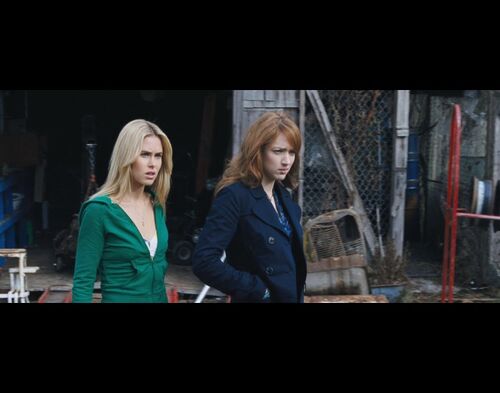
It is difficult to mention to entire representation of women in this film as there are only 2 main female characters. However, their roles are completely different and are made this way purposefully to fit with the purpose of the story. Stereotypically, women are used on screen to be domesticated or sexualised objects. This is addressed in the movie through Jules' sexualised nature and Dana's protective attitude towards her friends. However, both females slip in and out of these roles as at the beginning, Dana is just as bad as Jules for having an affair with her college tutor. The Final Girl theory clearly disproves the weakness of damsel-in-distress stereotypes as Dana is the last to survive along with Marty. However, this shows that she only survived with the help of her friend. Overall, women are presented in this film as sexual objects when it is expected of them, such as when they are in the cabin, but their strengths are emphasised throughout.
 |
| Jules and Dana. |


No comments:
Post a Comment