Paragraph 1
The term
Classical Hollywood Narrative was first established by Bulgarian structural
linguist, Tzvetan Todorov. His theory was formed on the common structure of any
story which seemed to cover the following areas:
- Equilibrium – In which the beginning of the story maintains a state of normality.
- Disruption of Equilibrium – Where the normality has been disrupted by an awful event or person.
- Recognition of Disruption – The ‘hero’ is exposed to the disruption and decides to do something to fix it.
- Attempt to Fix Disruption – In which the ‘hero’ and perhaps some other companions embark on a quest to restore normality.
- New Equilibrium – Not exactly the same as before, but a new state of normality has been found.
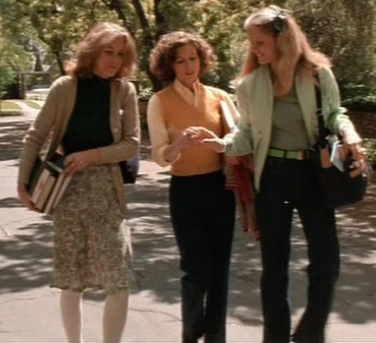 |
| State of Equilibrium - Laurie, Annie and Lynda chatting and walking home. |
Generally, Todorov found that any story will follow the
structure of Equilibrium, Disruption, New Equilibrium. This is useful in
helping us understand media texts as it not only breaks down the story, but it
also gives explanations for the previous event that occurred. For example, the
audience wouldn’t understand if the ‘hero’ went on a mission to correct a
disruption if a disruption hadn’t happened in the first place. A typical
convention of Hollywood films is always having a happy ending. However, in the
film Halloween, the ending is
specifically designed to leave you with a feeling of horror, as that is the
intention for the audience. The fact that Laurie was able to stab Michael at
the end gave the impression that the horror was over and a new equilibrium
could be established, but he rose again. Then after Michael was shot a further
6 times, it was easy to think that it truly was the end. However, when he disappeared
from where he fell, the fear returns as the audience is left with the
impression that he could be anywhere, and this is further emphasised by the
heavy breathing of Michael in the background before the end credits roll. This
is evidence that not all films give a happy ending, and it could be typically
conventional of horror films to do this as it gives the audience an authentic
feeling of terror which will play on their mind even after viewing.
Paragraph 2
Another
theorist to consider is Vladmir Propp. He established the various character
types found in Hollywood films and narrowed them down into a list of
stereotypical character types which feature in almost every film. These
character types are as follows:
- The villain(s) – the character who often creates the disruption within the narrative.
- The hero – the main protagonist and victor
- The donor – who provides an object to aid the hero, often has magical property.
- The princess – ‘reward’ for the hero and subject of villain’s schemes.
- Her father – who rewards the hero.
- The dispatcher – who sends the hero on his way.
- The false hero – double agent, could turn bad, tries to take credit for the hero’s work.
 |
| Michael Myers in the house with a knife - villain of the story. |
However, it is common in films to have one character play
more than one of these roles, for example, the donor and the helper could often
be the same person, as could the dispatcher and the princess’ father. Propp
focused a lot of his finding on folk tales and old stories, which means that as
times have changed, his findings may not be exactly the same in today’s media.
Having Propp’s list of characters is useful when understanding media texts as
it helps structure the story in terms of what is expected of those particular
characters. Also, having given them simple purposes in the story, it could be
easy to identify those different character types in any media text. However,
what also makes a good story, is when the audience is lead astray in terms of
believing a character is a certain type, but is something completely different
by the end. Characters like the ‘false hero’ are put in place to throw the
audience off and makes for a good thought-provoking story as any character
could be different to what was first presented. In Halloween, some of Propp’s characters are evident. The most obvious
one probably would be Michael Myers as the villain. His persona built up by the
other characters enables the audience to get an idea of how truly evil he is,
and this is backed up by the horrific events which follow on Halloween night.
Another character which is evident is the hero, although in this film the hero
is presented as a girl. This is unconventional as the stereotypical hero tends
to be male. Not many other of Propp’s characters are evident in this movie as
there isn’t a quest/mission to be set on, therefore a dispatcher and helper
isn’t needed.
Paragraph 3
The term Binary Opposition comes from the theorist Claude
Levi-Strauss, and he linked it to narrative structure. Binary opposites are
sets of opposite values which reveal the structure of media texts. Opposites such
as GOOD and EVIL tend to give the impression that the film is going to be about
heroes and villains. The audience were not too interested in looking at the
order in which events happened in the film, but more so on the deeper
arrangements of the themes. Particularly in Science Fiction films, it is clear
to identify sets of binary opposites:
- Earth/Space
- Good/Evil
- Humans/Aliens
- Past/Present
- Normal/Strange
- Known/Unknown
 |
| Laurie after stabbing Michael the first time. |
Looking at binary opposition within media texts is useful in
helping to understand them in terms of the films not being too ranged, and
being set on those two opposites it is good to see the attention to detail in
those specific differences rather than having too much going on. Also, having
binary opposites does make it more interesting for the audience as they aren’t
just concentrating on the plot structure and what happens next etc. They are
being interested in the deeper meanings of the themes and thinking about the
differences and feelings that come with them. 5 examples of binary opposites in
Halloween could be the Good/Evil
divide, being Myers is evil and Laurie is good. This is also supported by her
good nature in terms of her schoolwork and not smoking or drinking or having
sex. Another could be the Known/Unknown as by the end of the film, it is
unclear if Myers is actually human or not, as he cannot die. Therefore he is
unknown, against the known normality of town life Laurie and her friends live
in. Past/Present could be a relevant opposition, as it can be applied to Myers’
past in terms of murdering his sister back then, and returning to do the same
thing 10 years later. There is also a link to darkness/light in relation to
safety and danger. Michael reaps havoc at night whereas in the day time,
everyone is relatively safe. And finally, there is a theme of
innocence/stupidity in terms of Laurie’s virginality against the sexually
driven nature of her friends, which ultimately leads them to their deaths.
Paragraph 4
Theorists Bordwell and Thompson defined narrative every
clearly as “a chain of events in a
cause-effect relationship, occurring in time and space”. This essentially
means that the structure of the narrative will almost always be part of a cause
and effect sequence, meaning that an event will occur and then consequences
will follow. This repetitive chain-reaction will make up the film. The quote
‘in time and space’ outlines the setting of the narrative in terms of being set
in a particular time period, in a particular place. That will determine the
story. This quote is extremely useful in understanding media texts as it
defines the range of narratives, and makes it clear to the audience that the
narrative will happen for a reason (cause-effect) and always in a particular
time period and setting (time and space). It also is helpful when linking it to
Todorov’s narrative as it is a product of Bordwell and Thompson’s quote, just a
broken down version.
In Halloween,
there are a few moments in the film which are a direct effect of a causal
factor. 2 of them are:
-
The use of sex as an indicator as to when a character will die – Annie is on her way to get her boyfriend (to have sex), and is strangled by Michael in the car. Similarly, Lynda and her boyfriend, Bob have sex in the Annie’s house, and both of them are soon killed by Michael. In other words – SEX (cause) – DEATH (effect).
Lynda before she is killed by Michael. - Another is the detailed point which possibly sets the whole film off, which is at the beginning where Laurie drops the keys off at Michael’s old house and he sees her through the window. This meant that he had a target for the rest of the film, and then followed her and eventually killed her friends to get to her. Although is unsuccessful at the end.
There are also elements of the film which we don’t see
actually on-screen, but we know what has happened. 2 examples are:
- At the beginning between Michael killing his sister and then escaping the mental institution, we know he has attended and been monitored by Dr Loomis, as he tells us that.
-
At the end when Dr Loomis shoots Michael 6 times and he falls of the balcony, the camera goes to him lying on the ground, dead. However, when the camera returns to that same shot a little while later, Michael is gone. Although we don’t see him actually getting up, we know that he has risen again and is on the loose. This is also reinforced by the heavy breathing we hear in the background before the end credits roll.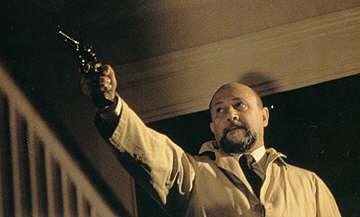
Dr Loomis saving Laurie from Michael.
Halloween (John Carpenter, 1978)
1.How does the start exemplify a common
technical code convention of the horror genre? |
| Michael as a boy after he killed his sister. |
The starting scene is a point-of-view shot from Michael as a
boy. This is a conventional technical code as we can’t see the face of the
killer, but we can see his intentions. As well as not being able to see the
killer, we don’t know his appearance. We as an audience only find out Michael
is a boy at the end of the scene where he is standing outside the house in his
costume with a bloody knife. The purpose of using this shot is to create
suspense and mystery and we don’t know who he is, and also the restricted
vision can obstruct the view of what he is going to do, until it happens.
2. How does the setting fit in with the horror
genre?
The setting isn’t a typical horror setting as it isn’t
isolated. Normally, horror films are set in isolated, dark places in order for
crimes to be committed and the likelihood of being found out is minimal. The
fact that it is a small, close community means that the killer is more likely
to be discovered. However, the TIME the film is set is more conventional as
Halloween night is a time for pranks and dressing up, which is the perfect
cover for the villain. This is supported by the fact that when Laurie is
banging on the door of her neighbours she is neglected and the lights are
turned off. This could be because of the nature of teenagers playing tricks,
and the older generation don’t want anything to do with it. Therefore Laurie’s
actions are mistaken for a prank on the neighbourhood.
 |
| Close houses, busy streets, big houses. |
3. What iconography of “innocence” do we hear
or see early on?
The main symbol of “innocence” in the film would be Laurie’s
character and we are shown evidence of this early on in terms of her dress,
attitude and personality. The fact that she doesn’t smoke, or when she tried to
was coughing and not experienced. This showed that she lives a clean and safe
lifestyle, but could succumb to peer pressure easily. Another area of innocence
could come from Tommy and Lindsey, who are the children Laurie is babysitting
that night. Their innocent fears of the “Boogeyman” are reflections of
innocence and lack of bravery, but also wild imagination.
 |
| Laurie in school, studying, not wearing revealing clothing. |
4. What was the main industry impact of Halloween?
 |
| Halloween Logo. |
The fact that the film was cheap to make and didn’t include
any big names made the success-rate very profitable. The iconic use of this
film in later years made it one of the best-selling horror films of that time,
and it is classed as one of the classics in present day horror standards.
5. Name some “Slasher” films which followed on
from Halloween.
Some “slasher” films that came after Halloween include Friday the
13th in which the immortal approach similar to Myers is
replicated in Jason, as well as chasing after teenagers. Others are Prom Night, Terror Train, Bloody Valentine,
Night School, The Burning, The Prowler and Friday the 13th Part 2.
 |
| Jason from Friday The 13th. |
6. What are
the four plot rules of the “slasher film sub-genre which Halloween began?
There were typical plot rules in which horror-slasher films
seemed to follow in order to get the best effects and reactions from the
audience. These included:
- A traumatic event in the past creates a psychopathic killer. (Myers killed his sister as a boy).
- The killer returns to the site of the event, usually on a significant date later on. (Halloween).
- The killer stalks and graphically kills a group of obnoxious teens from both sexes. (Annie etc).
- A ‘final girl’ survives, usually boyish and often virginal, to thwart the killer. (Laurie).

Annie calling her boyfriend.
The character of Laurie is portrayed as androgynous by
Carpenter to conform to the plot rules. Laurie shows characteristics of being
boyish and more mature in ways such as:
- Her voice is deeper and more grown up than the other girls’ and more mature.
- She has a strong jawline, which could be seen as a masculine feature.
- Apart from the first time we see her, she wears trousers for the rest of the film.
Laurie before she stabs Michael second time.

The fact that Laurie becomes the ‘Final Girl’ because of her
virginal status could suggest that the agenda for Myers killing the others
could be because of their sexual natures. The fact that Laurie survives but her
sexualised friends all perish could show that by involving themselves in sexual
activity, it could be putting them in danger with the villain. This could also
be seen as a moral message in the film that sex is bad, and follows the rules
of survival in horror films such as, don’t drink, don’t do drugs and don’t have
sex.
 |
| Lynda and Bob in bed together. |
9. How does
the director, John Carpenter, counter the suggestion that Halloween had a reactionary sexual agenda?
There is the argument that there wasn’t a reactionary sexual
agenda in Halloween as Annie, who was
the first to be killed, didn’t actually engage in sexual activity before she
died. It can be stated that she was on her way to pick up her boyfriend, and
their sexual intensions could be questioned. However, she didn’t actually
commit a sexual act, which could suggest that the reason for her death could be
placed elsewhere.
10. Why does
Michael Myers kill his sister?
I can be argued, in addition to the previous question, that
Myers killed his sister in the beginning of the film because she had sex with
her boyfriend. Coincidentally, she died just after having sex. And the argument
could commence due to Myers trying to graphically copy what her boyfriend had
just done to her. The repetitive stabbing motion used to kill her could
represent the sexual action between Judith and her boyfriend. However, there is
a more simple explanation for Myers crime, and that is backed up by Dr Loomis
who states about midway through the film, that Michael Myers is simply evil.
There is no other explanation needed for his crimes other than the fact that
‘there was something terribly evil behind those eyes’.
 |
| Annie dead with Judith Myers missing tomb stone. |
Narrative Structures and The Crazies (Eisner, 2010)
1. Does The Crazies follow the CHN? Why or why
not?
The Classic Hollywood Narrative is evident in elements of The Crazies as there is a disruption in
the form of the outbreak of the virus, recognition of disruption in terms of
David, Judy and the deputy discovering what had happened, and an attempt to
resolve disruption as David turned off
the water supply to stop it spreading too far. However, the CHN has been
altered and swapped around in order to create more suspense and to have a
hard-hitting effect on the audience at the end. For example, instead of showing
the state of equilibrium at the beginning, there is a shot of the town in
flames and the banner falling across the screen. This would create an
unsettling feeling for the audience as they know what is yet to become of the
equilibrium later on in the story. Another example of how CHN is not followed
in this film is the ending. The fact that the virus has spread to the other
town and they are about to embark to the whole fiasco again leaves the audience
feeling ultimately disappointed for the ‘heroes’ as they have triumphed
throughout the entire film, only to have to go through it all again, with no
certain outcome of success.
 |
| David and Judy attempt to rebuild their lives. |
2. How many
of Propp’s character types can be identified in the film?
There are a few of Propp’s character types evident in the
film, but some are unclear. For example, there is no clear villain. However,
the government could be classed as the evil source given how they’ve handled
the situation and killed EVERYONE, even if they were fine. There are clear
heroes, and the first is David, the Sheriff. He is the one who survives at the
end, and escapes the evil of the town, although not entirely as he has to go
through the whole ordeal again in the next one. His wife, Judy could be classed
as the Princess as she is classed as the fragile one due to her pregnant state,
and also the fact that she is the one who is captured, tied up and hunted
throughout the film, but it always saved by David. The deputy conformed to the
role of the helper as he accompanied the hero on the journey, however this
character could also fall into the role of the false hero when he turns on them
with the gun. But this is all explained in terms of him becoming infected, and
he redeems himself by sacrificing his life to the government in order for David
and Judy to escape.
 |
| Deputy beginning to go crazy. |
3. List 5
examples of binary oppositions in the film and explain them briefly.
Some binary oppositions are evident in the film, and these
are:
-

A character succumbed to disease. Human/Non-human - Diseased/Healthy
- Morality/Immorality
- Insane/Sane
- Authority/Chaos

Some of these binary oppositions feed into one another, but
they all address the different themes and challenges facing the characters and
leads the narrative structure to go the way it went.
Looking at time and space within a film, it is easier to
break it up to make it more understandable for the audience. In the film, there
are a few durations, meaning time periods, used to indicate when an event
occurred. Here are some:
- The period of the emergence of the virus. When Rory comes out onto the baseball field through to the water being shut off.
- The ‘round-up’ of the townsfolk and organised into infected and non-infected categories.
- The escape from the town and extermination of the life David and Judy left behind.
Rory on the baseball field with a gun.

It is important to think about why events in the film
happened, and that things must have occurred before the film begins in order
for the narrative to make sense. Here are 2 examples:
- The plane crash – We never saw the plane actually crash, but we find out during the film that the plane was carrying the disease which infected the whole town.
- Judy and David wanting to have a baby – they probably had to discuss it all and go shopping for things for the nursery. We only see the finished nursery.
Judy in the nursery.

There are parts in this film that are invisible to the
audience, although we know that it is happening. Some parts are as follows:
- The part in which Judy was taken away at the ‘round-up’ and the camera followed David for a particular amount of time, however we know that she is being taken somewhere and something is happening to her, as David assures us that he is coming back for her.
- When the virus becomes airborne, the audience knows that it can be traveling somewhere else, perhaps to the next town. However we can’t see it travelling, we’re only going on the characters’ words.
 |
| Judy being taken away by the officials. |

No comments:
Post a Comment